


From reading memory addresses (0x7ffeefbff5c0) and SHA-256 checksums to configuring Linux file permissions (chmod 755), subnet masks, and CSS hex colors (#4F46E5), computer science constantly shifts between Binary (Base 2), Octal (Base 8), Decimal (Base 10), and Hexadecimal (Base 16).
Worse, standard JavaScript calculators silently corrupt any integer above 2^53 - 1 (9,007,199,254,740,991)—breaking 64-bit Snowflake IDs, 128-bit UUIDs, and 256-bit cryptographic hashes due to IEEE-754 floating-point rounding!
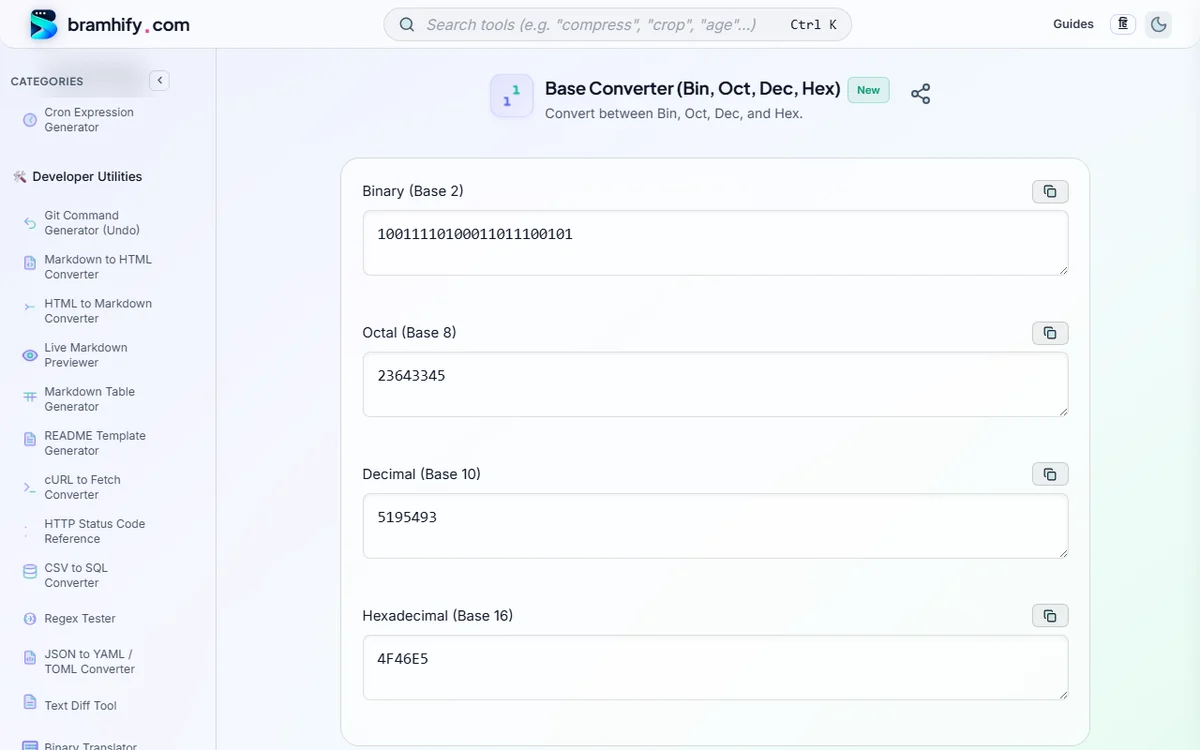
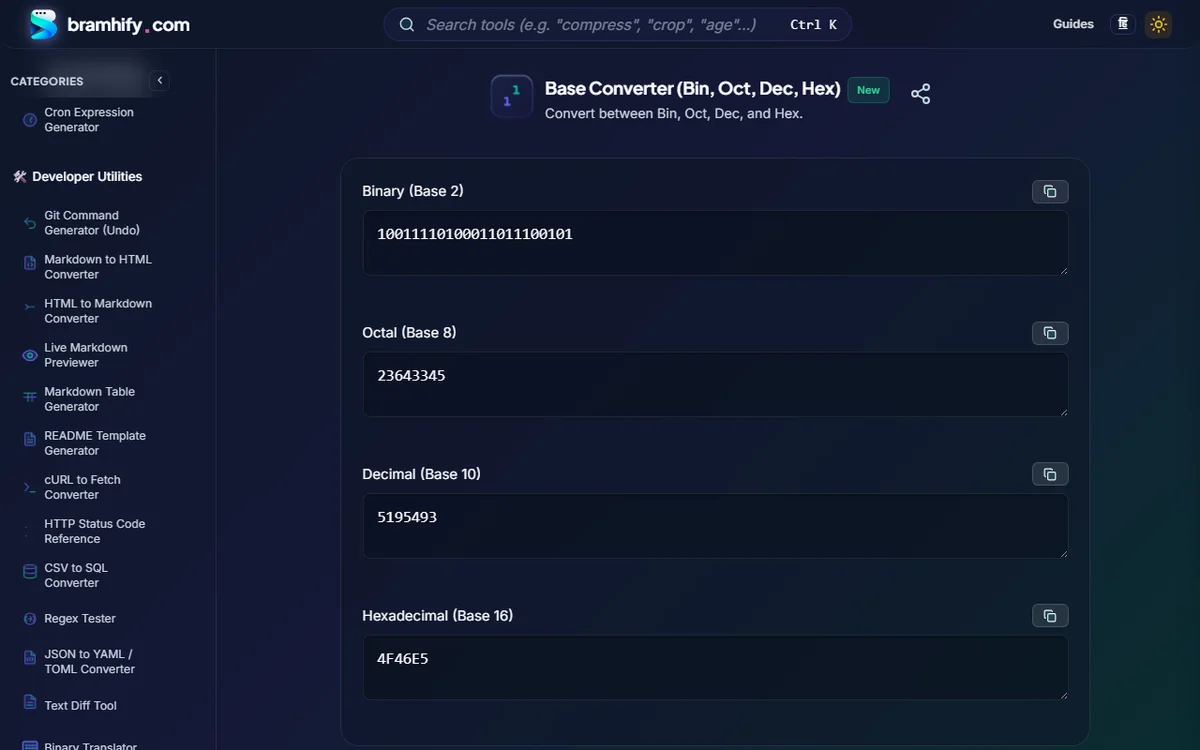
Bramhify's 100% offline Base Converter uses native JavaScript BigInt for arbitrary-precision conversion across all four bases simultaneously—type in any one field and watch Binary, Octal, Decimal, and Hexadecimal update live with zero precision loss and zero server calls.
Master 4-Bit Nibble Conversion Table (0 through 15)
Because 16 = 2^4 and 8 = 2^3, memorizing just these 16 rows lets you convert ANY hexadecimal or octal number to binary in your head—zero long division needed!
| Decimal (Base 10) | Hexadecimal (Base 16) | Binary (Base 2 — 4-bit Nibble) | Octal (Base 8) |
|---|---|---|---|
0 | 0 | 0000 | 0 |
1 | 1 | 0001 | 1 |
2 | 2 | 0010 | 2 |
3 | 3 | 0011 | 3 |
4 | 4 | 0100 | 4 |
5 | 5 | 0101 | 5 |
6 | 6 | 0110 | 6 |
7 | 7 | 0111 | 7 |
8 | 8 | 1000 | 10 |
9 | 9 | 1001 | 11 |
10 | A | 1010 | 12 |
11 | B | 1011 | 13 |
12 | C | 1100 | 14 |
13 | D | 1101 | 15 |
14 | E | 1110 | 16 |
15 | F | 1111 | 17 |
Convert Binary, Octal, Decimal & Hex with BigInt Precision Offline:

Instant Grouping Shortcuts (Zero Long Division!)
Hexadecimal ↔ Binary (Group by 4 Bits)
Every single hex digit maps cleanly to 4 binary bits (one nibble). To convert 0x2A to binary:
2→0010A(10) →1010- Combine:
00101010(42in decimal!)
Octal ↔ Binary (Group by 3 Bits)
Every single octal digit maps cleanly to 3 binary bits. That is why Unix chmod permissions (r=4, w=2, x=1) use Octal!
chmod 755→7(111=rwx),5(101=r-x),5(101=r-x)!
Real-World Engineering Places Each Base Appears
| Base | Literal Prefix (JS / Python / C) | Real-World Engineering Examples |
|---|---|---|
| Binary (Base 2) | 0b101010 | Bitmasks, feature flags, TCP header flags, IPv4 CIDR subnetting |
| Octal (Base 8) | 0o755 | Linux/Unix chmod file permissions (0o644, 0o600, 0o755) |
| Decimal (Base 10) | 42 | Human counters, HTTP ports (443, 8080), Unix timestamps |
| Hexadecimal (Base 16) | 0x2A / #4F46E5 | CSS RGB colors (2 hex chars = 1 byte 0–255), MAC addresses, SHA-256 digests, UTF-8 byte dumps |
Quick Base Conversion in JavaScript & Python
// JavaScript BigInt — zero precision loss on 64-bit / 256-bit integers!
const big = BigInt("0xDEADBEEF12345678");
console.log(big.toString(10)); // "16045690981402826360"
console.log(big.toString(2));  // "1101111010101101101111101110111100010010001101000101011001111000"
console.log(big.toString(8));  // "1572555735704432126360"
# Python handles arbitrary-precision integers natively
n = int("DEADBEEF12345678", 16)
print(bin(n), oct(n), hex(n))
Frequently Asked Questions (FAQs)
Why do programmers use Hexadecimal instead of Binary?
Binary strings get unreadable very quickly—a single 64-bit memory address takes 64 0s and 1s! Because each Hexadecimal character (0–9, A–F) compactly represents exactly 4 bits, a 64-bit integer shrinks to just 16 crisp hex characters and a full byte (0–255) fits in exactly 2 characters (00 to FF).
Why did another online base converter give the wrong decimal answer for my 64-bit hex ID?
Standard JavaScript parseInt(hex, 16) converts to a 64-bit IEEE-754 floating-point number, which loses integer precision above 2^53 - 1 (9,007,199,254,740,991). Bramhify uses native BigInt, preserving 100% exact digits even on 128-bit UUIDs and 256-bit SHA hashes.
What is the difference between Base Converter and Binary to Text (ASCII)?
A Number Base Converter translates pure numeric values (e.g., decimal 65 = hex 41 = binary 1000001). A Binary Translator encodes readable text characters ("Hello") using ASCII/UTF-8 character tables. For text-to-binary strings, use our Binary to Text & ASCII Cheat Sheet.
Why is chmod 755 written in Octal?
Each Unix permission triad has 3 binary bits: Read (4), Write (2), and Execute (1) (4+2+1 = 7). Octal digits 0–7 map 1-to-1 onto those 3 permission bits for Owner, Group, and Public. Try our interactive Linux chmod Permissions Guide to practice!
Need to calculate IPv4 binary subnet masks or inspect SHA-256 hex digests?
Pair this converter with our IPv4 Subnet & CIDR Calculator Guide and SHA-256 & MD5 Hash Generator Guide.