


For over a decade, backend teams faced an uncomfortable tradeoff when choosing database primary keys: auto-incrementing integers (BIGSERIAL) were blazing fast on B-tree indexes but leaked business metrics (/orders/1042) and broke distributed inserts, while UUID v4 eliminated central coordination but shredded PostgreSQL and MySQL InnoDB write performance at scale.
In May 2024, RFC 9562 standardized UUID v7—combining a 48-bit millisecond Unix timestamp prefix with 74 bits of cryptographic randomness—joining ULID as the modern gold standard for time-ordered distributed keys.
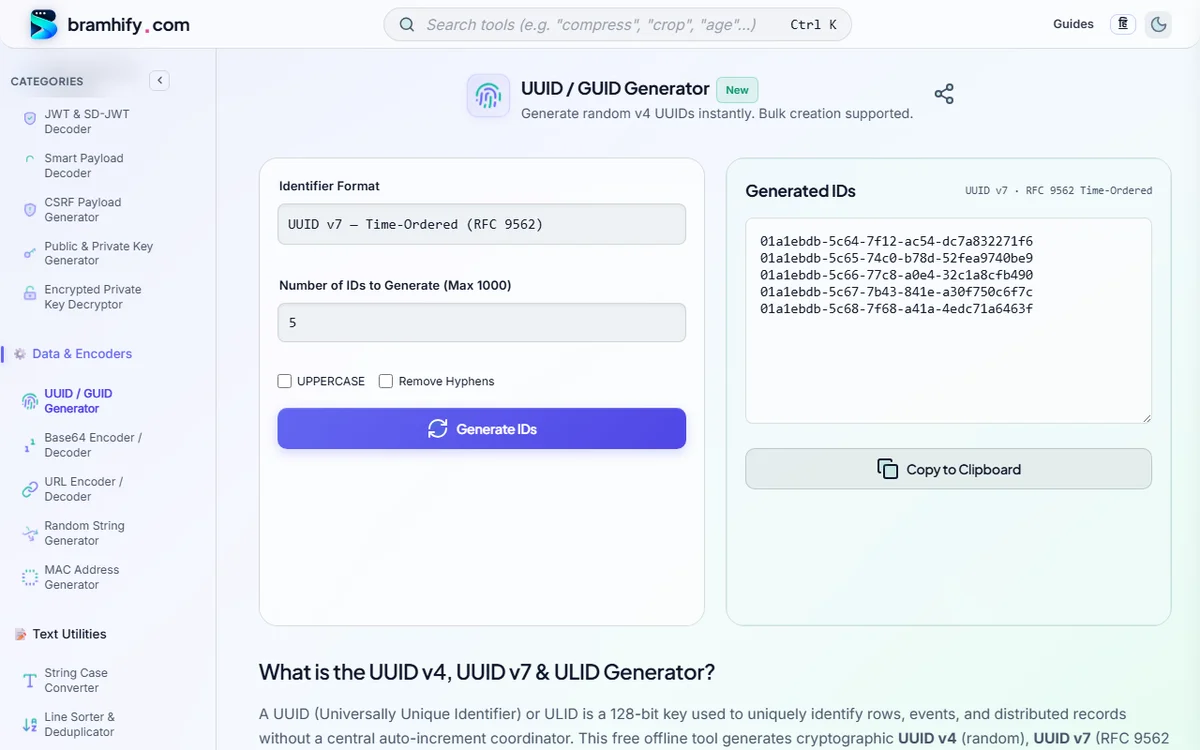
Bramhify's 100% offline UUID v4, UUID v7 & ULID Generator lets you generate up to 1,000 cryptographic IDs at once using your browser's native Web Crypto CSPRNG (crypto.randomUUID() & crypto.getRandomValues()), with uppercase and hyphen-free options—zero server calls, zero logged keys.
Head-to-Head Comparison: UUID v4 vs. UUID v7 vs. ULID vs. Auto-Increment
| Property | Auto-Increment (BIGINT) | UUID v4 (Random) | UUID v7 (RFC 9562) | ULID |
|---|---|---|---|---|
| Size | 64-bit (8 bytes) | 128-bit (16 bytes) | 128-bit (16 bytes) | 128-bit (16 bytes) |
| String Format | 1048576 | 550e8400-e29b-41d4-... (36c) | 01933e1a-7c2b-7d40-... (36c) | 01JCYE3B7K8M9N2P4Q6R... (26c) |
| Chronologically Sortable? | Yes | No (pure random) | Yes (48-bit Unix ms) | Yes (48-bit Unix ms) |
Native PostgreSQL uuid Type? | N/A | Yes | Yes (drop-in!) | Requires extension or BYTEA/CHAR(26) |
| B-Tree Index Locality | Excellent | Poor (page splits!) | Excellent (append-only) | Excellent (append-only) |
| Leaks Creation Timestamp? | Leaks row count | No | Yes (to nearest ms) | Yes (to nearest ms) |
Generate Bulk UUID v4, UUID v7 & ULID Keys Locally:

Why Random UUID v4 Hurts Large PostgreSQL & MySQL Tables
Relational databases store B-tree primary-key indexes in fixed-size memory/disk pages (8 KB in PostgreSQL, 16 KB in MySQL InnoDB).
- When you insert random UUID v4 values into a 50-million-row table, every new row lands in a random leaf page across the entire index! That causes constant cache misses (random disk I/O), heavy WAL write amplification, and 50% page splits that bloat index size by 30–50%.
- When you insert UUID v7 or ULID values, the first 48 bits strictly increase with wall-clock milliseconds (
Date.now()). Almost every new row appends smoothly to the rightmost hot leaf page in RAM—delivering auto-increment-like write speed while staying 100% globally unique across microservices!
Inside the 128-Bit Layout of RFC 9562 UUID v7
 0                   1                   2                   3
 0 1 2 3 4 5 6 7 8 9 0 1 2 3 4 5 6 7 8 9 0 1 2 3 4 5 6 7 8 9 0 1
+-+-+-+-+-+-+-+-+-+-+-+-+-+-+-+-+-+-+-+-+-+-+-+-+-+-+-+-+-+-+-+-+
|                           unix_ts_ms                          |
+-+-+-+-+-+-+-+-+-+-+-+-+-+-+-+-+-+-+-+-+-+-+-+-+-+-+-+-+-+-+-+-+
|          unix_ts_ms           |  ver  |       rand_a          |
+-+-+-+-+-+-+-+-+-+-+-+-+-+-+-+-+-+-+-+-+-+-+-+-+-+-+-+-+-+-+-+-+
|var|                        rand_b                             |
+-+-+-+-+-+-+-+-+-+-+-+-+-+-+-+-+-+-+-+-+-+-+-+-+-+-+-+-+-+-+-+-+
|                            rand_b                             |
+-+-+-+-+-+-+-+-+-+-+-+-+-+-+-+-+-+-+-+-+-+-+-+-+-+-+-+-+-+-+-+-+
- 48 bits (
unix_ts_ms): Big-endian Unix epoch milliseconds (good until the year 10,889 AD!). - 4 bits (
ver): Fixed0111(7). - 2 bits (
var): Fixed10(RFC 9562 variant). - 74 bits (
rand_a+rand_b): Cryptographically secure random entropy — allowing millions of conflict-free IDs per millisecond across distributed nodes.
Which One Should You Pick in 2026?
- Choose UUID v7 (Default Winner for SQL Databases): If you use PostgreSQL (native
uuidv7()landed in PostgreSQL 18!), MySQL (BINARY(16)), SQLite, or GraphQL/OpenAPI specs expecting standard 36-char UUIDs. Zero migration pain fromuuidcolumns. - Choose ULID (Best for URLs, Logs & NoSQL): If you want shorter, case-insensitive, double-click-selectable 26-character strings (
01JCYE3B7K...) without hyphens for DynamoDB sort keys, Stripe-style resource slugs, or human-readable support ticket IDs (Crockford Base32 intentionally omits confusing lettersI,L,O, andU). - Choose UUID v4 (Best for Security Tokens & Privacy-Sensitive IDs): If leaking the exact millisecond a user signed up or an invoice was created is a privacy concern! For password-reset tokens, API keys, or session secrets, always use pure random UUID v4 (or 256-bit CSPRNG bytes via our Strong Password Generator).
Frequently Asked Questions (FAQs)
Is UUID v7 a drop-in replacement for existing PostgreSQL UUID columns?
Yes! UUID v7 uses the exact same 128-bit binary format and 8-4-4-4-12 hex string syntax as UUID v4. Existing PostgreSQL uuid columns, ORMs (Prisma, Drizzle, Hibernate, Eloquent), and JSON Schema "format": "uuid" validators accept UUID v7 immediately with zero schema changes.
Can someone decode the creation time from a UUID v7 or ULID?
Yes. Both UUID v7 and ULID store the 48-bit Unix millisecond timestamp right in their leading bits. If exposing exact record creation timestamps publicly is undesirable (for example, hiding account creation times in public URLs), keep UUID v4 for external public IDs.
Are UUIDs generated in Bramhify cryptographically secure?
Yes. Bramhify relies exclusively on your browser's native Web Crypto CSPRNG (crypto.randomUUID() and crypto.getRandomValues()), never Math.random(). All 1 to 1,000 IDs are generated locally in memory with zero network traffic.
Should I store UUIDs as VARCHAR(36) or native UUID / BINARY(16)?
Never store UUIDs as VARCHAR(36) in high-volume tables—that wastes 36+ bytes per row plus UTF-8 collation overhead. Use native UUID in PostgreSQL (16 bytes) or BINARY(16) with UUID_TO_BIN(id, 0) in MySQL 8+.
Want to inspect the millisecond timestamp inside a UUID v7 or debug API keys offline?
Decode timestamps cleanly with our Unix Epoch Timestamp Guide, or generate cryptographic RSA/Ed25519 keys in our JWT Key Pair Guide.